How to Read Your Society's Trial Balance and Balance Sheet
A fifteen-minute guide for members and committees: what the trial balance, income and expenditure account and balance sheet show, and five questions that reveal whether the accounts are healthy.
At every AGM a stack of financial statements gets passed around, and most members flip straight to the last page looking for one number. Committee members who weren't treasurers often feel the same. This guide shows you how to read your society's trial balance and balance sheet in fifteen minutes, and the five questions that tell you whether the accounts are healthy.
 Photo:
The three statements, in one line each
- Trial balance: a list of every account in the books with its balance, debits on one side, credits on the other. If the two totals match, the books are arithmetically complete. That doesn't make them right.
- Income & expenditure account: what the society earned and spent during the year, and whether it ran a surplus or a deficit. For a non-profit society it plays the role a profit and loss statement plays for a company.
- Balance sheet: a snapshot on the last day of the year. What the society owns (assets) against what it owes and holds for members (liabilities and funds).
The trial balance is the raw material. The other two are built from it.
Reading a trial balance
Here is a simplified year-end trial balance for a 40-flat society:
| Particulars | Debit (₹) | Credit (₹) |
|---|---|---|
| Members' Sinking Fund | 4,50,000 | |
| Maintenance & Service Charges | 28,80,000 | |
| Staff Salaries | 9,60,000 | |
| Common Electricity | 4,20,000 | |
| Repairs & Upkeep | 3,10,000 | |
| Bank Accounts | 13,75,000 | |
| Members' Dues Receivable | 2,65,000 | |
| Grand Total | 33,30,000 | 33,30,000 |
Read it from top to bottom:
- Funds and liabilities sit on the credit side. The sinking fund is members' money held for a purpose. It is not income. (We explain why in sinking fund vs repairs fund.)
- Income is on the credit side: maintenance billed to members for the year.
- Expenses are on the debit side: salaries, electricity, repairs.
- Assets are on the debit side: money in the bank, and what members still owe.
- The totals match: ₹33,30,000 on each side.
Many Indian societies and their auditors still use Tally, whose trial balance shows an Opening balance, the period's Debit and Credit transactions, and a Closing balance marked Dr or Cr for each account. The idea is the same. Each row tells you where the account started, what moved, and where it ended.
Why matching totals isn't the whole story
A trial balance will happily balance even if a ₹50,000 repair bill was posted to "Electricity", or a member's payment was credited to the wrong flat. Matching totals mean the arithmetic is right. Whether each entry is right is what the audit and the five questions below are for.
Reading the balance sheet
The balance sheet groups the same accounts into two sides on the last day of the year:
Liabilities and funds: members' sinking fund, repairs fund, other funds, advances received from members, amounts owed to vendors, and the accumulated surplus.
Assets: bank balances, fixed deposits, members' dues receivable, deposits paid (electricity, water), and any fixed assets such as generators or CCTV equipment.
Both sides total to the same figure. That's what "balance" means.

Five questions every member should ask
1. Are the funds backed by real money?
Add up the sinking fund and repairs fund balances on the liability side. Then look at bank balances and fixed deposits on the asset side. If the funds total ₹25 lakh but the society has only ₹8 lakh in the bank and FDs, the fund money has been spent on something else. That's the most important warning sign in society accounts.
2. How large are members' dues receivable?
Divide the receivable by a year's maintenance billing. In our example, ₹2,65,000 ÷ ₹28,80,000 ≈ 9%, a bit over one month of billing. A figure creeping towards 15–20% means arrears are building up and recovery needs attention. Our guide on recovering dues from defaulters lawfully covers what to do.
3. Did the society run a surplus or a deficit, and why?
A deficit in one year can be fine. A large repair may have fallen in that year. A deficit three years running means maintenance is set too low, and the gap is being quietly filled from the funds.
4. Are there large "suspense" or "miscellaneous" balances?
Amounts parked in Suspense, Sundry or Miscellaneous accounts are entries nobody has classified. A few hundred rupees is housekeeping. Lakhs is a question for the treasurer.
5. Does the bank balance match the bank statement?
Ask whether a bank reconciliation was done at year end. The balance in the books should match the bank statement, with any difference explained by cheques issued but not yet cleared. An unreconciled bank balance makes every other number less reliable.
What a member is entitled to see
Under most state co-operative laws and model bye-laws, members can inspect the society's audited accounts and receive copies of the statements presented at the AGM, often on payment of a nominal fee. Your bye-laws set out the procedure. Asking these questions is a member's right, not an accusation.
Quick quiz: read the trial balance
Here is a simplified year-end trial balance. Read it, then pick your answers. Tap a question's button to reveal the answer.
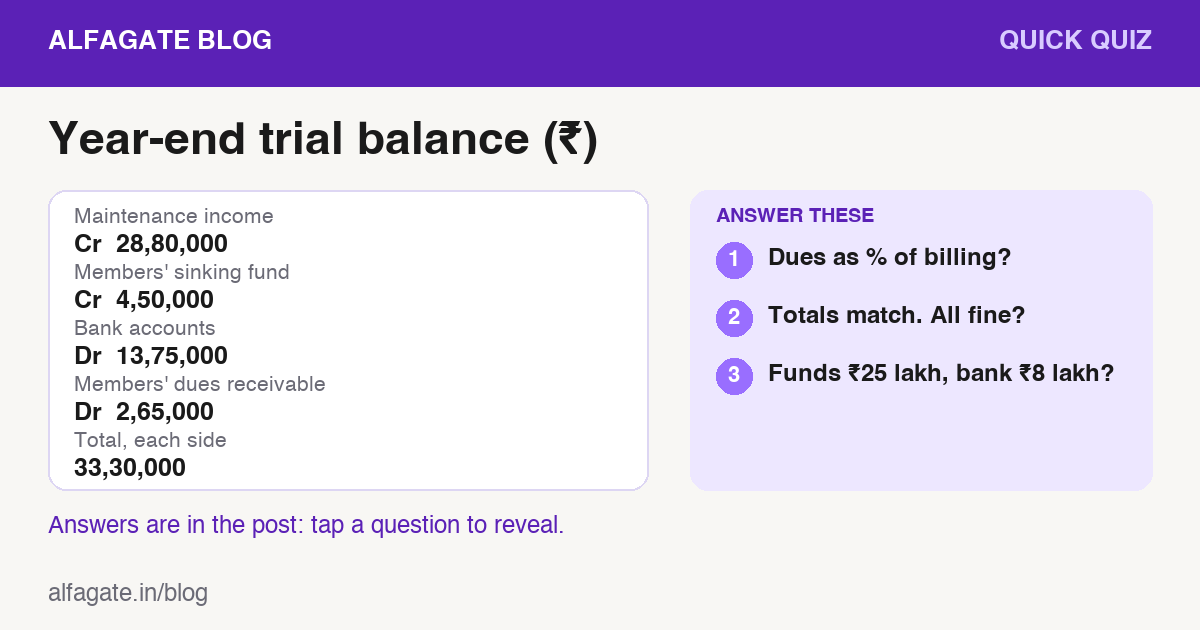
Q1. Dues receivable are ₹2,65,000 against ₹28,80,000 of yearly billing. About what percentage is that?
- A. 9%
- B. 19%
- C. 0.9%
Show answer
A. ₹2,65,000 ÷ ₹28,80,000 ≈ 9.2%, a little over one month of billing. Creeping towards 15–20% would mean arrears are building.
Q2. Both sides total ₹33,30,000. Does that prove there are no mistakes?
- A. Yes, it balances
- B. No. A bill posted to the wrong account still balances
- C. Only if it was printed from Tally
Show answer
B. Matching totals only mean the arithmetic is complete. A ₹50,000 repair posted to Electricity, or a payment credited to the wrong flat, still balances. That's what audit and the five questions are for.
Q3. The sinking and repairs funds total ₹25 lakh, but bank balances and FDs are only ₹8 lakh. What does it suggest?
- A. Healthy accounts
- B. Fund money has been spent on something else
- C. Normal rounding
Show answer
B. Funds should be backed by real money. A gap this size means money collected for a purpose was used elsewhere, the most important warning sign in society accounts.
Got a question your society is stuck on? Send it to us, and we may answer it in a future post.
How AlfaGate helps
AlfaGate runs a full double-entry ledger for the society. Every bill, receipt, vendor payment and FD goes into the books as it happens, so the trial balance, income and expenditure account and balance sheet are always current, not rebuilt at year end. The trial balance follows the Tally layout auditors already know, with opening and closing balances marked Dr/Cr, and every statement exports as a print-ready PDF on your society's letterhead. See it with your own society's numbers.
General information, not accounting advice. Statement formats and audit requirements depend on your state's co-operative law and your auditor's practice.

Khunt Jenish P.
Software developer at AlfaStack, building AlfaGate to make society management smarter, simpler, and more connected.