Sinking Fund vs Repairs Fund: How Much Should a Society Collect?
What the sinking fund and the repairs and maintenance fund are each for, the minimum rates in the Maharashtra model bye-laws, a worked ₹ example, and how both should appear in your books.
Ask ten members what the sinking fund is for and you'll get ten answers: "for emergencies", "for redevelopment", "it's just part of maintenance". Ask what the repairs and maintenance fund is for and most people won't know the society has one. Getting sinking fund vs repairs fund right is the difference between a building that gets its terrace waterproofed on time and one that sends every flat a ₹40,000 special demand after a bad monsoon.

The short version
| Sinking fund | Repairs & maintenance fund | |
|---|---|---|
| What it pays for | Major structural work and reconstruction, decades out | Regular, recurring repairs: painting, plumbing, waterproofing, lift overhauls |
| How often it is spent | Rarely, and usually with general body approval | Every year or two |
| Minimum contribution (Maharashtra model bye-laws) | 0.25% p.a. of the construction cost of the flat | 0.75% p.a. of the construction cost of the flat |
| Can it pay for monthly expenses? | No | No |
Both are ring-fenced funds: money collected for a specific purpose, held separately from the society's day-to-day income. Neither should pay the electricity bill.
What the bye-laws say
Under the Maharashtra model bye-laws for co-operative housing societies (bye-law 13), contributions to the sinking fund and the repairs and maintenance fund are a minimum percentage of the construction cost of each flat. That's the cost certified by the society's architect, excluding land. The general body can decide a higher rate, but not a lower one.
Other states' model bye-laws have similar but not identical rules. Some fix the sinking fund as a percentage of construction cost, others leave it to the general body, and some RWAs registered as societies or associations have no statutory floor at all. Check your own registered bye-laws: they're the rule your auditor will test against.
Why construction cost, not maintenance?
Because the purpose is to save towards rebuilding or major structural work, which scales with what it cost to build the structure, not with what the society spends on security guards. That's also why a well-run society periodically updates the architect-certified construction cost. A figure certified in 1998 badly understates what reconstruction would cost today.
A worked example
Take a 40-flat society. The architect certifies a construction cost of ₹6 crore (excluding land). For simplicity, assume all flats are the same size, so each flat's share of construction cost is ₹15 lakh.
Sinking fund at 0.25% p.a.
- Society: ₹6,00,00,000 × 0.25% = ₹1,50,000 per year
- Per flat: ₹15,00,000 × 0.25% = ₹3,750 per year, or ₹312.50 a month
Repairs and maintenance fund at 0.75% p.a.
- Society: ₹6,00,00,000 × 0.75% = ₹4,50,000 per year
- Per flat: ₹15,00,000 × 0.75% = ₹11,250 per year, or ₹937.50 a month
So about ₹1,250 of each flat's monthly bill goes into the two funds, before any of the running costs we break down in how society maintenance charges are calculated. Where flats differ in size, each flat's share of construction cost differs too, and so does its contribution.
Is that enough?
Run it forward. ₹1,50,000 a year for 20 years is ₹30 lakh before interest. If the society keeps it in fixed deposits, it grows further. That's real money, but it won't fully rebuild a building whose construction cost is ₹6 crore today and far more in 20 years. That's why many societies choose a rate above the minimum, and why the money must never be raided for running expenses.
Five mistakes committees make
- Merging the funds into maintenance income. If the sinking fund is just a line on the bill but goes into the same bank account and the same income ledger as everything else, it gets spent. Post it to its own fund account in the books, and ideally keep it in a separate bank account or FDs.
- Spending the sinking fund on routine repairs. Waterproofing, painting and pump replacement are what the repairs fund is for. Using the sinking fund for them shrinks the money set aside for major structural work.
- Never updating the construction cost. A rate applied to a 25-year-old figure collects far too little.
- Not earning anything on the money. Lakhs sitting in a current account for years is a missed opportunity. Fixed deposits with a scheduled bank are the usual choice. Track every FD's maturity date so none sits unrenewed for months.
- No resolution behind the spending. Withdrawals from the sinking fund should be backed by a general body resolution recording the purpose and amount. Auditors look for it.
How to show the funds in your books
In double-entry accounts, each fund is a liability-side fund account (members' money held for a purpose), not income. When a member is billed:
- the member's account is debited with the full bill
- Service charges income is credited with the running-cost portion
- Sinking Fund and Repairs & Maintenance Fund are credited with their portions
When the society invests the fund in an FD, the bank balance falls and an FD asset rises. The fund balance doesn't change. When it spends the repairs fund on waterproofing, the expense is charged against the fund, as the bye-laws and your auditor require. At year end the balance sheet should show each fund's balance, matched by the investments and bank balances holding it.
If your trial balance shows one large "maintenance received" figure and no fund accounts, that's the first thing to fix. Our guide to reading your society's trial balance and balance sheet walks through what to look for.
Quick quiz: the ₹6 crore society
Use the numbers on the card, then pick your answers. Tap a question's button to reveal the answer.
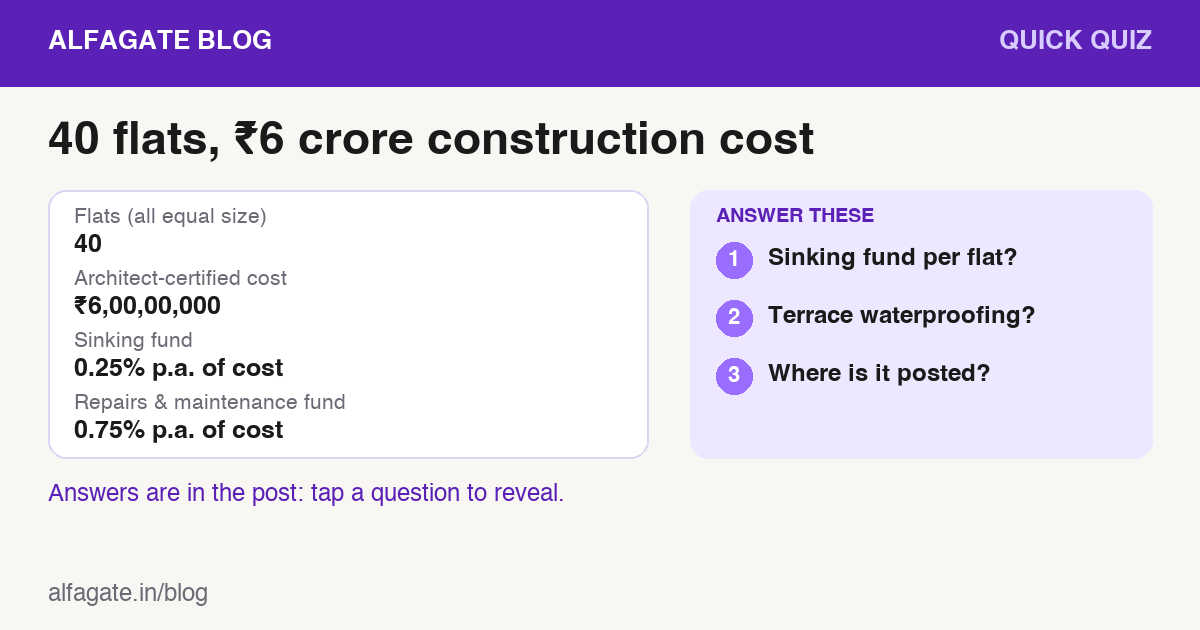
Q1. Each flat's share of construction cost is ₹15 lakh. What is the yearly sinking fund contribution per flat?
- A. ₹3,750
- B. ₹11,250
- C. ₹1,50,000
Show answer
A. ₹15,00,000 × 0.25% = ₹3,750 a year, about ₹312.50 a month. (₹11,250 is the repairs fund share at 0.75%, and ₹1,50,000 is the whole society's sinking fund.)
Q2. The terrace needs waterproofing this year. Which fund should pay for it?
- A. Sinking fund
- B. Repairs & maintenance fund
- C. Whichever has more cash
Show answer
B. Regular, recurring work (painting, plumbing, waterproofing, lift overhauls) belongs to the repairs & maintenance fund. The sinking fund is kept for major structural work and reconstruction.
Q3. In the society's books, where do sinking fund contributions belong?
- A. In maintenance income
- B. In their own fund account on the liability side
- C. In the secretary's personal account
Show answer
B. Funds are members' money held for a purpose, not income. Posting them to a separate fund account (ideally with their own bank balance or FDs) is what stops the money being spent on day-to-day costs.
Got a question your society is stuck on? Send it to us, and we may answer it in a future post.
How AlfaGate helps
In AlfaGate, sinking fund and repairs fund contributions are separate bill heads that post to their own fund accounts, so the balance sheet shows them correctly without year-end journal entries. Fixed deposits are recorded against the bank that funded them, with maturity tracking. The trial balance, balance sheet and income and expenditure statement come out ready for the auditor. Book a demo to see it with your own society's numbers.
General information only. Contribution rates and how the funds may be used are set by your state's co-operative law and your society's registered bye-laws. Confirm with your auditor before changing contribution rates.

Khunt Jenish P.
Software developer at AlfaStack, building AlfaGate to make society management smarter, simpler, and more connected.