Maintenance Defaulters: A Lawful Recovery Process for Societies
Notice, interest, Registrar recovery and the January 2026 Bombay High Court ruling — a step-by-step, lawful way to recover society maintenance dues, and what a committee must never do.
Every committee has the list: a handful of flats that are three, six, sometimes eighteen months behind on maintenance. The pressure from paying members is real — "why should I pay when they don't?" — and so is the temptation to do something dramatic. This guide sets out a lawful process for recovering maintenance dues from defaulters, step by step, and the shortcuts that land committees in more trouble than the arrears were worth.

First, who counts as a defaulter?
The word gets used loosely in WhatsApp groups, but it has a specific meaning. Under the Maharashtra model bye-laws, a member becomes a defaulter when dues stay unpaid for more than three months after a written notice demanding them. Other states use similar wording, but read your own state's co-operative act and your society's registered bye-laws before acting. They, not a committee member's memory, decide the timelines.
This matters because almost every later step depends on it. Interest, recovery applications and a member's right to contest committee elections all hinge on the formal defaulter status, not on "he's always late".
Step 1: Make the bill impossible to dispute
Most recovery cases that go badly start with a sloppy bill. Before chasing anyone, check that:
- the maintenance formula (per sq ft, per flat, or a hybrid) is written in the bye-laws or a general body resolution, which we cover in how society maintenance charges are calculated
- each bill shows its heads separately: service charges, sinking fund, repairs fund, parking, interest
- the member's ledger shows every bill, every receipt and the running balance, with dates
If a member can say "I never got a breakdown" or "I paid in cash in June", and your records can't answer immediately, sort out the records first.
Step 2: Reminder, then a formal notice
Start with a polite reminder by SMS, email or app notification. Many "defaults" are a changed bank account, an NRI owner who has lost track, or a tenant who assumed the owner was paying.
If that fails, send a formal written notice that states:
- the amount outstanding, broken down bill by bill
- the interest rate that applies and the bye-law or resolution that authorises it
- a clear deadline to pay (bye-laws usually prescribe the minimum period)
- what the society will do next if the dues remain unpaid
Send it in a way you can prove later, such as registered post or email with a delivery record, and keep a copy against the flat's ledger. The three-month defaulter clock usually runs from this notice.
Step 3: Charge interest, but only what your bye-laws allow
Interest on arrears is the society's normal, lawful lever. The Maharashtra model bye-laws (bye-law 72, 2014 version) allow simple interest of up to 21% per annum, at the rate the general body decides. Revised draft bye-laws have proposed a lower cap, so check whether your state has notified a newer version before you set your rate.
A worked example at 18% p.a. simple interest:
| Amount | |
|---|---|
| Monthly maintenance | ₹6,000 |
| Months unpaid | 4 (₹24,000 outstanding) |
| Interest on first month's ₹6,000 for 4 months | ₹360 |
| Interest on second month's ₹6,000 for 3 months | ₹270 |
| Interest on third month's ₹6,000 for 2 months | ₹180 |
| Interest on fourth month's ₹6,000 for 1 month | ₹90 |
| Total interest | ₹900 |
Two common mistakes: charging compound interest (interest on interest) when the bye-laws allow only simple interest, and charging a flat "penalty" of ₹500 or ₹1,000 that no general body ever approved. Both get overturned and undermine the rest of your case.
Step 4: Recovery through the Registrar
When notices and interest don't work, the co-operative law gives societies a remedy that is much faster than a civil suit. In Maharashtra, after the 2019 amendment, housing societies apply under section 154B-29 of the Maharashtra Co-operative Societies Act for a recovery certificate. The Registrar examines the society's accounts and notice, hears the member, and if satisfied, issues a certificate that can be executed like a decree. Ultimately that can include attaching property.
Other states have equivalent provisions, for example recovery through the Registrar or a Co-operative Court. The application usually needs:
- a general body or managing committee resolution authorising recovery
- the member's ledger extract and copies of bills
- copies of the notices and proof they were delivered
- the bye-law clauses on contribution and interest
This is exactly where clean accounts pay off. An application backed by a ledger that reconciles to the books is a strong one.
Old dues are still dues
A frequent defence is that the dues are "too old to recover". In January 2026 the Bombay High Court, in Aspandiar Rashid Irani & Gustad Rashid Irani v. Pasayadan CHS, held that a member's obligation to pay society charges is a continuing liability. It upheld recovery under section 154B-29 against the argument that the claim was time-barred, and held that those occupying the flat were liable. Committees in Maharashtra can take some comfort from this, though each case still turns on its own facts.
What a society must NOT do
This is where well-meaning committees get it wrong.
- Do not cut water or electricity. Courts and consumer forums have repeatedly held that water and electricity are essential services tied to the right to life under Article 21. A society cannot disconnect them to recover dues, however large. A committee that does it risks a police complaint, a consumer case, and losing the moral high ground in its own recovery case.
- Do not block lifts, parking or entry for the member, their family or their domestic staff.
- Do not publicly shame. Posting names and amounts in WhatsApp groups or on notice boards with a hostile tone invites defamation complaints, and, under the DPDP Act, raises questions about processing personal data for a purpose residents didn't consent to. A neutral "list of defaulters" circulated only as your bye-laws permit, such as with the AGM notice, is a different matter. Read your bye-laws.
- Do not refuse a sale NOC for unrelated reasons. You can ask for dues to be settled as part of a transfer, but don't use the NOC as leverage for things the bye-laws don't cover.
Prevention beats recovery
The cheapest default is the one that never builds up. Societies that keep arrears low tend to share four habits:
- Bills go out on the same date every month, with a payment link, not a photo of a handwritten amount.
- Members can see their own ledger: what they were billed, what they paid, what's pending. Disputes drop sharply when the numbers are visible.
- Reminders are automatic at 7, 15 and 30 days, so no committee member has to make the awkward phone call.
- Interest is applied consistently, to everyone, every month. Selective waivers are what create resentment and legal challenges.
Quick quiz: Flat B-304 ledger
Study the ledger card, then pick your answers. Tap a question's button to reveal the answer.
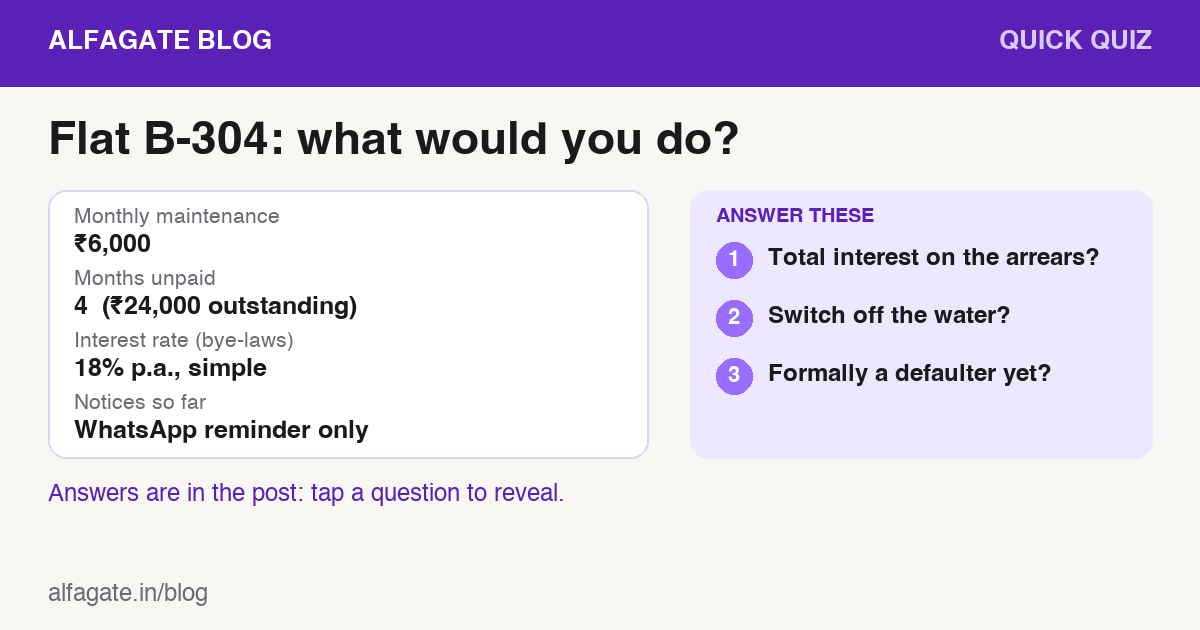
Q1. Each month's ₹6,000 has been unpaid for 4, 3, 2 and 1 months respectively. What is the total simple interest at 18% p.a.?
- A. ₹900
- B. ₹1,440
- C. ₹4,320
Show answer
A. Each bill earns interest only from its own due date: ₹6,000 × 18% ÷ 12 = ₹90 per month of delay, and 4 + 3 + 2 + 1 = 10 bill-months, so ₹900. Charging 18% on the whole ₹24,000 for 4 months (₹1,440) overcharges, and ₹4,320 is a full year's interest on the whole sum.
Q2. The committee wants to pressure B-304 by cutting its water supply. Can it?
- A. Yes, after 3 months of default
- B. Yes, if the general body votes for it
- C. No. Water is an essential service
Show answer
C. Courts and consumer forums treat water and electricity as essential services. A society cannot disconnect them to recover dues, even with a general body vote. Use notice, interest and Registrar recovery instead.
Q3. Under the Maharashtra model bye-laws, when does a member become a formal defaulter?
- A. As soon as one bill is a day late
- B. When dues stay unpaid for over 3 months after a written notice
- C. When the committee says so in the WhatsApp group
Show answer
B. The defaulter clock normally starts from the formal written notice, which is why Step 2 of the process matters. B-304 has had only a WhatsApp reminder, so the clock has not started. Check your own state's act and bye-laws.
Got a question your society is stuck on? Send it to us, and we may answer it in a future post.
How AlfaGate helps
AlfaGate keeps a proper double-entry ledger for every flat. Bills, receipts, interest and adjustments all post to the society's books, so the ledger extract you attach to a recovery application ties out to the trial balance your auditor sees. Residents see their dues and pay from the app, and the committee sees who is overdue and by how long, without anyone maintaining a separate spreadsheet.
If your committee is spending its evenings chasing arrears, book a demo and we'll walk you through it on your own society's numbers.
This article is general information for housing society committees, not legal advice. Laws, bye-laws and court rulings vary by state and change over time. Consult your society's legal adviser before starting recovery proceedings.

Khunt Jenish P.
Software developer at AlfaStack, building AlfaGate to make society management smarter, simpler, and more connected.