DPDP Act for Housing Societies: What Changes at the Gate
The DPDP Rules notified in November 2025 apply to the visitor, staff and resident data your society collects. What the law asks, the penalties, and a nine-step checklist for committees.
Every day your society's gate collects personal data: visitor names, mobile numbers, flat numbers, vehicle plates, photos, sometimes ID cards. For years nobody thought twice about it. That changed when the Digital Personal Data Protection (DPDP) Rules, 2025 were notified on 14 November 2025, bringing India's data protection law, the DPDP Act 2023, into force in phases. This post explains what the DPDP Act means for housing societies, especially visitor management, in plain language.

Does the DPDP Act apply to a housing society?
Very likely, yes. The Act applies to anyone who decides why and how digital personal data is processed. The Act calls that person a Data Fiduciary. There's no exemption for co-operative housing societies, RWAs or apartment associations. If your society keeps residents' and visitors' details in a gate app, a spreadsheet, a WhatsApp group or a billing system, it's processing digital personal data.
Paper registers on their own fall outside the Act. But the moment those entries are scanned, typed into a system or photographed, they're digital personal data.
The Government has given organisations an 18-month phased window from notification to comply with most of the substantive obligations, which puts the deadline around mid-2027. That sounds far off, but changing how a gate works, retraining guards and cleaning up years of old visitor data all take time.
What data does a typical society hold?
It's more than most committees realise:
- Residents: names, mobile numbers, email, flat number, family members, vehicle numbers, ownership or tenancy documents
- Visitors: name, phone number, purpose, photo, sometimes an ID card number
- Domestic staff and drivers: names, photos, addresses, ID documents, police verification
- Vendors and delivery staff: names, phone numbers, company
- CCTV footage, where it can identify a person
- Financial data: maintenance ledgers, bank details for refunds
The five things the law asks of a society
1. Collect only what you need, for a stated purpose
A society should be able to answer, for each field it collects, why it needs it. A visitor's name, phone number and flat being visited serve a clear security purpose. A scanned Aadhaar card for every Swiggy delivery is hard to justify. Taking a full ID copy as routine, when a name and phone number would do, is the clearest example of over-collection.
2. Give a clear notice and take consent where it is the basis
The Rules require a notice that's separate, clear and plain, stating what data you collect and for what specific purpose, so people can give informed consent. For a visitor, that can be a short notice at the gate or in the app ("Your name, phone number and photo are recorded for the safety of residents and deleted after N days").
3. Keep it safe
Societies must take reasonable security safeguards: access only for people who need it, passwords and PINs, no shared logins, and no exports emailed around. A guard's phone with the full visitor history and no lock screen is a risk. So is a committee WhatsApp group full of residents' Aadhaar photos.
4. Don't keep it forever
Personal data should be deleted once its purpose is served, unless a law requires you to keep it. Decide a retention period for each kind of data. For example, visitor logs might be kept for 90 days unless needed for an incident, and staff verification records for as long as the person works in the society. Then actually delete the data once that period is up.
5. Respect people's rights, and report breaches
Residents and visitors have the right to access, correct, update and erase their data, and to nominate someone to exercise these rights on their behalf. If data is breached, the society must inform the Data Protection Board and affected people.
The penalties are not small
The DPDP Act sets out penalties per instance, up to:
| Failure | Maximum penalty |
|---|---|
| Not taking reasonable security safeguards to prevent a breach | ₹250 crore |
| Not notifying a breach / violations relating to children's data | ₹200 crore |
| Other violations | ₹50 crore |
These are maximums, and the Board must consider proportionality and the nature of the organisation, so a 60-flat society isn't going to be fined like a bank. But the direction is clear. "We're just a society" won't work as a defence, and committee members won't want to be the ones explaining a leak.

A practical checklist for your committee
- Map your data. List every place personal data lives: the gate app, the billing system, spreadsheets, email inboxes, WhatsApp groups, paper files.
- Cut what you don't need. Stop photocopying IDs for routine visitors. Stop collecting fields nobody uses.
- Write and display a privacy notice at the gate, in the app and with new-member forms. Keep it short and specific.
- Fix access. Each guard and committee member gets their own login. Remove access the day a guard or committee member leaves.
- Set retention periods and make sure your software can delete old data.
- Stop the WhatsApp leaks. Don't post residents' phone numbers, documents or defaulter details in large groups.
- Name a point of contact for data requests and complaints, and record how quickly you respond.
- Pass a managing committee resolution adopting the policy, so it outlives the current committee.
- Ask your software vendor where the data is stored, who can access it, and how they'll help you meet access and deletion requests.
What this means for visitor management
The good news: a well-designed digital gate is easier to make DPDP-compliant than a paper register. A register sits open on the guard's desk for anyone to read. A good system shows a guard only what they need, records who accessed what, and can delete visitor entries after a set period.
When you review your visitor process, look for:
- per-person logins for guards, ideally with a PIN on a trusted device rather than a shared password
- pre-approval by residents, so the guard isn't collecting more than necessary at the gate
- role-based visibility, where a guard sees today's expected visitors, not the society's full history
- configurable retention, so old visitor logs actually get deleted
AlfaGate's visitor management was built around these principles: resident pre-approvals, individual guard logins with PIN on trusted phones, and access by role. If you're reviewing your gate process ahead of the DPDP deadline, talk to us. And if you're tightening the books too, see our guide to handling maintenance defaulters lawfully, which covers why naming and shaming defaulters is now riskier than ever.
Quick quiz: spot the gate problems
Look at this gate scenario, then pick your answers. Tap a question's button to reveal the answer.
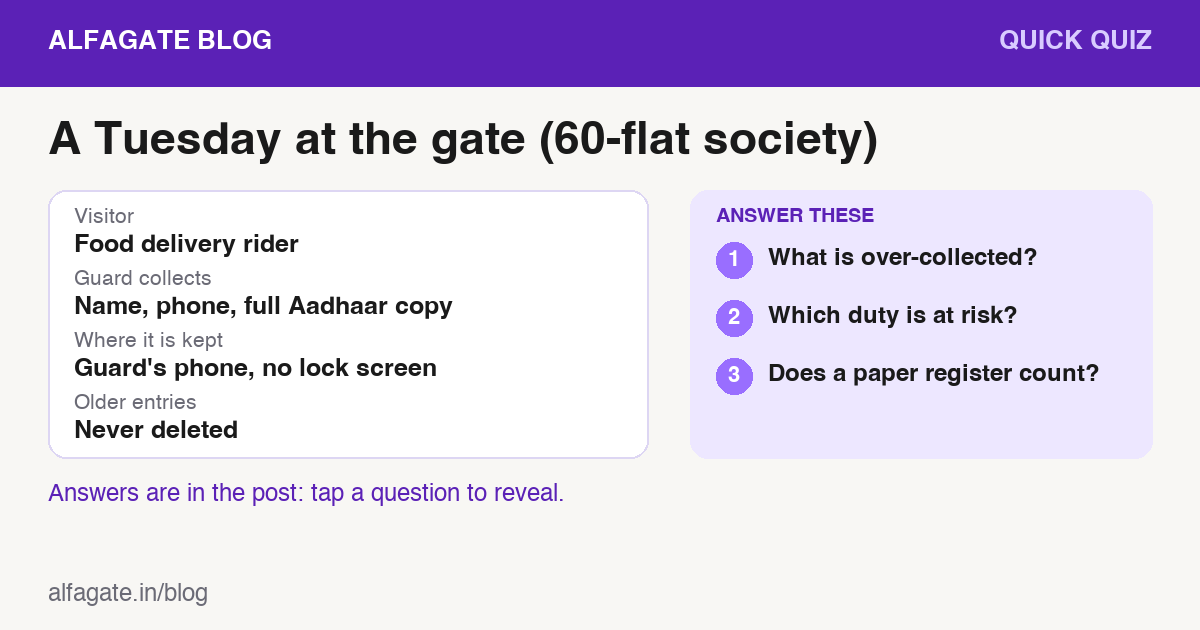
Q1. Which item is hardest to justify for a routine delivery?
- A. Name
- B. Phone number
- C. A full Aadhaar copy
Show answer
C. Collect only what you need for a stated purpose. A name, phone number and flat visited serve the security purpose. A full ID copy for every delivery is the clearest example of over-collection.
Q2. The guard's phone holds the visitor history with no lock screen. Which obligation does that put at risk?
- A. Giving a notice
- B. Taking reasonable security safeguards
- C. Letting people withdraw consent
Show answer
B. Reasonable security safeguards (individual logins, PIN or lock, access only for those who need it) is the duty whose breach carries the highest penalty in the Act, up to ₹250 crore as a maximum.
Q3. The society keeps a paper register that is never scanned or typed anywhere. Does the DPDP Act cover it?
- A. Yes, always
- B. No. The Act covers digital personal data, and paper stays outside until it is digitised
- C. Only for societies with over 100 flats
Show answer
B. The Act applies to digital personal data. A paper-only register falls outside it, but the moment entries are scanned, typed or photographed they become digital personal data.
Got a question your society is stuck on? Send it to us, and we may answer it in a future post.
This article is general information, not legal advice. The DPDP Rules are being implemented in phases. Check the latest notifications from the Ministry of Electronics and IT, and consult a professional for your society's specific situation.

Khunt Jenish P.
Software developer at AlfaStack, building AlfaGate to make society management smarter, simpler, and more connected.