Domestic Help and Staff Entry: Verification Without Humiliation
One registration, flat-wise access, timings, and a clean-up every six months: how societies can verify domestic staff and drivers safely and respectfully.
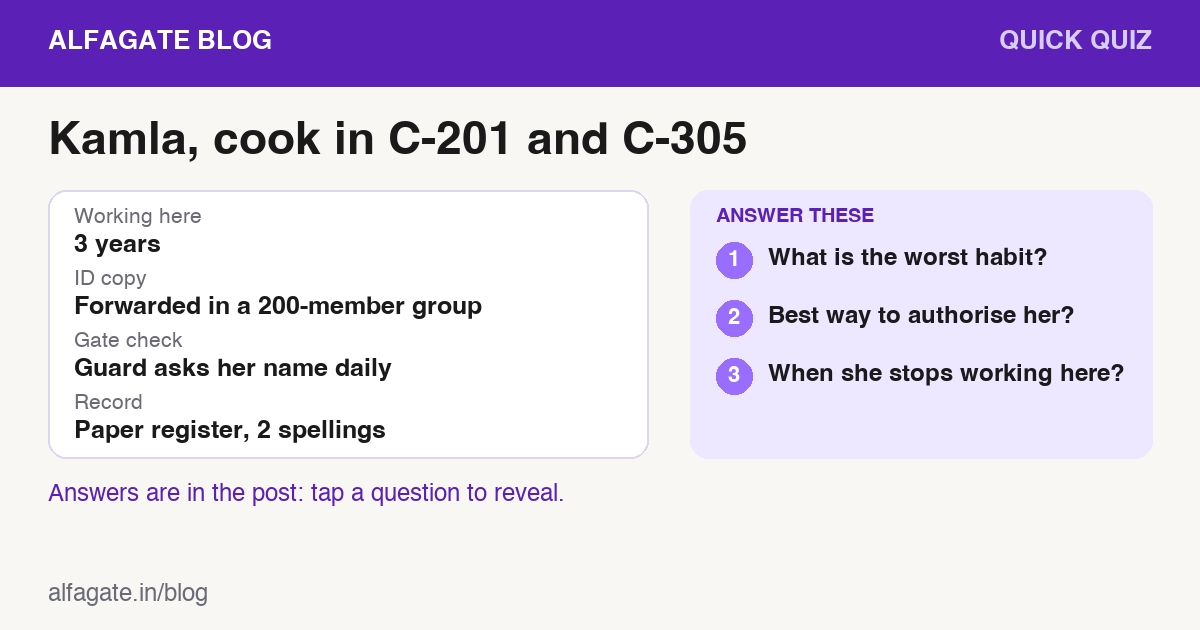
The woman who has cooked in Flat C-201 for three years is stopped at the gate every morning and asked her name, as if she'd never been there. The new guard doesn't know her, the register has her under two spellings, and her ID copy is somewhere in a WhatsApp group with 200 members. This is how most societies handle domestic help and staff entry: awkward for the people who work here, and not much safer for the people who live here. This guide covers a better way: verification that protects residents and treats staff with respect.
Why the usual system fails both sides
Look at what typically happens:
- The guard decides on the spot. Anyone who looks confident walks in; anyone who looks nervous is questioned. That's judgement, not security.
- Verification happens once, then never again. A police verification from 2021 and a photo on someone's phone. Nobody notices when a person stops working in the society but keeps coming in.
- Documents travel. Aadhaar and PAN photos are forwarded between residents "so the guard can check". Each forward is a copy nobody controls, and under the DPDP Act it is exactly the sort of casual handling that creates liability. See our guide on what the DPDP Act changes at the gate.
- The register is the only record, and registers can't answer "who entered flat C-201 between 8 and 10 on Tuesday?"
What good looks like: four principles
1. Register the person once, by the society, not by every resident
A domestic helper working in four flats should have one profile: name, photo, the flats they're authorised for, and a verification status. Not four different entries in four residents' phones.
2. Tie access to flats and timings
"Allowed in C-201 and C-305, 7 am to 6 pm" is a rule a guard can follow without judging anyone. Entry outside the pattern (a Sunday, an unfamiliar flat) is flagged for a quick call to the resident, which is what a security system is for.
3. Collect the minimum, store it properly
Ask what each document is for. A photo and name at the gate serve the entry purpose. A police verification certificate serves a trust purpose and can sit with the committee office, not in a group chat. An ID copy you don't need is a liability you don't need. Define a retention period, and delete records when the person stops working in the society.
4. Make leaving as easy as joining
When a resident says "Kamla no longer works with us," that flat is removed from her access the same day. When she stops working in every flat, her society pass is closed. This is the step most societies skip entirely.
A simple onboarding flow
Here's a flow that works for most societies:
- The resident requests registration for their helper, with the helper's consent.
- The society office records name, photo and mobile number, and notes whether verification (police verification or an employer reference) has been seen.
- The helper gets a pass: a QR code, a PIN, or at minimum a photo the guard can match.
- The helper's flats and working hours are set, and the resident can change them.
- Each entry and exit is logged automatically, with a time and the flat.
- Every six or twelve months, the society reviews the list and removes anyone who has no active flat.
Handling the awkward questions
"Is police verification mandatory?" That depends on your state and local police rules and on the society's own bye-laws or house rules. Many societies make it a condition for registration. Check your local police station's process, and don't invent a rule the general body hasn't passed.
"Can we refuse entry to staff without verification?" A society can set reasonable entry rules through its bye-laws or a general body resolution, applied equally to everyone. Selective or arbitrary refusals invite complaints.
"Should the helper's details be visible to all residents?" No. Residents see their own helpers. The guard sees who is expected today. The committee sees the register. Nobody needs the full list with phone numbers on a notice board.
"What about drivers, cooks, nannies and tutors?" The same process, with different timings. A tutor who comes for an hour doesn't need a monthly pass; a one-time pre-approval does the job.
Dignity is a security feature
A system that is predictable for staff is also easier for guards to run. When a helper knows exactly what is needed to enter (show the pass, say the flat), there's no interrogation and no friction. When guards have clear rules, they stop improvising. And when residents know the process, they stop asking the guard to "just let her in".
Think of your own experience. If you were stopped and questioned every morning, you'd resent the building, and you'd stop trusting the system that did it.
Quick quiz: Kamla at the gate
Read the situation on the card, then pick your answers. Tap a question's button to reveal the answer.
Q1. Which practice creates the biggest privacy risk?
- A. Giving her a pass
- B. Forwarding her ID copy in a large group
- C. Noting her working hours
Show answer
B. Each forward is a copy nobody controls. Keep verification documents with the committee office, share only what the guard needs, and set a retention period.
Q2. Which is the better access rule for a guard to follow?
- A. Allow anyone who looks confident
- B. Allowed in C-201 and C-305, 7 am to 6 pm
- C. Ask the guard to decide each day
Show answer
B. Rules tied to flats and timings are clear for the guard and respectful for the helper. Entry outside the pattern is flagged for a quick call to the resident.
Q3. When Kamla stops working in every flat of the society, what should happen to her pass?
- A. Nothing, it expires in a year
- B. It is closed the same day
- C. It is kept in case she returns
Show answer
B. Closing access promptly is the step most societies skip. Make leaving as easy as joining, and delete records after the retention period.
Got a question your society is stuck on? Send it to us, and we may answer it in a future post.
How AlfaGate helps
AlfaGate has a domestic help module: each helper has a profile, is assigned to the flats they work in, and has attendance and ratings recorded against them, so "who works where" lives in one place instead of four residents' phones. At the gate, residents pre-approve visitors, guards sign in with individual logins and a PIN on trusted phones, and each guard sees who is expected today rather than the society's full history. To see how it would work at your gate, book a demo.
General information for housing society committees, not legal advice. Verification requirements vary by state and local police practice. Check them with your local authorities and your society's legal adviser.

Khunt Jenish P.
Software developer at AlfaStack, building AlfaGate to make society management smarter, simpler, and more connected.