Society Parking Policy: Allotment, Visitors and Enforcement
Four ways to allot parking, seven clauses every policy needs, a fair enforcement ladder and a one-page template for your committee.
Parking is where the politeness of a society goes to die. Somebody's visitor parks in somebody else's slot, a second car appears where a bicycle used to be, a tenant's SUV blocks the fire lane, and the WhatsApp group lights up at 11 pm. Almost every one of these fights comes from the same gap: no written parking policy. This guide shows how to build a housing society parking policy: allotment, visitor rules, charges and enforcement, that survives the next dispute.
Start by counting what you have
Before any rule, write down three numbers:
- Slots available: covered, open, stilt, basement. Count the marked bays, not what people think is possible.
- Vehicles registered: cars and two-wheelers, per flat.
- Slots allotted: to whom, on what basis, and since when.
In most societies the third number is a mystery, and the gap between the first and second is the real problem. Walk the parking areas once on a weeknight and once on a Sunday morning and note what's parked where.
Four ways to allot parking
| Method | How it works | Works best when |
|---|---|---|
| Fixed, with the flat | Each flat gets a numbered slot, as at sale | Slots were allotted at purchase and recorded |
| Lottery | Slots drawn publicly, re-drawn at intervals | Slots are scarce and unallotted |
| First come, first served with a waiting list | Applications are dated, slots offered in order | Slots free up occasionally |
| Paid, tiered | Second and third vehicles pay more | Demand far exceeds supply |
Whichever you choose, record the allotment in a register (flat, slot, vehicle number, date, charge) and publish the list to members. Disputes about who has what lose their heat once the list is on the notice board.
Check before you charge. Whether a society may charge for parking space that was sold with the flat, and how stilt or open parking is treated, depends on your state's law, the sale agreements and your bye-laws. Take legal advice before introducing a charge for something members believe they already bought.
The seven clauses of a parking policy
1. Who may park, and how many vehicles
State the limit per flat (for example, one slot per flat, and additional vehicles only if slots are free). Include tenants and say whether the owner's or tenant's vehicle has priority.
2. How slots are allotted and reallotted
Which method above, how applications work, and how a slot returns to the pool when a member sells, rents out or no longer owns a vehicle.
3. Vehicle registration and stickers
Every vehicle gets a registered number and a sticker or tag. A vehicle without one is treated as a visitor's. This single rule removes most "whose car is this?" calls to the guard.
4. Visitor parking
Set the number of visitor bays, the maximum stay (for example four hours), and what happens after: a notice, then a fee, then a lawful request for the owner to move it. Many societies cap overnight visitor parking and ask residents to pre-register guests.
5. Two-wheelers, cycles and EVs
Decide where each goes. If you expect EV charging, say now how charging points will be approved and billed, so that nobody installs a wire to their slot overnight.
6. Charges and penalties
Charges must be in the bye-laws or a general body resolution. A penalty that no one voted on is the easiest thing for a member to challenge. List each charge and each penalty, and who can waive it (ideally nobody, except by committee resolution).
7. Enforcement, step by step
A fair enforcement ladder looks like this:
- Photograph the violation, with date and time.
- Notice on the windshield or message to the registered owner.
- Second notice, copied to the flat's record.
- Penalty per the policy, added to the flat's bill.
- Escalation to the committee for repeat or safety violations.
Never deflate tyres, lock wheels, or block a vehicle in without a clear rule and legal advice. Retaliation turns a parking issue into a police complaint.
Safety comes before convenience
Some violations are not a matter of manners:
- Fire lanes and exits. A vehicle that blocks a fire-engine path or a staircase door is a safety breach. Tow-away rules for these should be explicit.
- Ramps and bends. Mark no-parking zones on the ground.
- Speed. Speed limits and humps where children play.
A simple template
Copy these headings into a one-page policy and fill in the numbers:
| Heading | Your rule |
|---|---|
| Entitlement | __ slot(s) per flat |
| Extra vehicles | Allowed if free, at ₹__ per month |
| Visitor bays | __ bays, max __ hours |
| Registration | Sticker with vehicle number, renewed every __ |
| Penalties | ₹__ for first violation, ₹__ for repeat |
| Fire lane / exit blocking | Notice, then removal at owner's cost |
| Review | Every year at the AGM |
Pass it by committee resolution (and general body where charges are involved) and publish it with the register.
Quick quiz: the parking squeeze
Read the card, then pick your answers. Tap a question's button to reveal the answer.
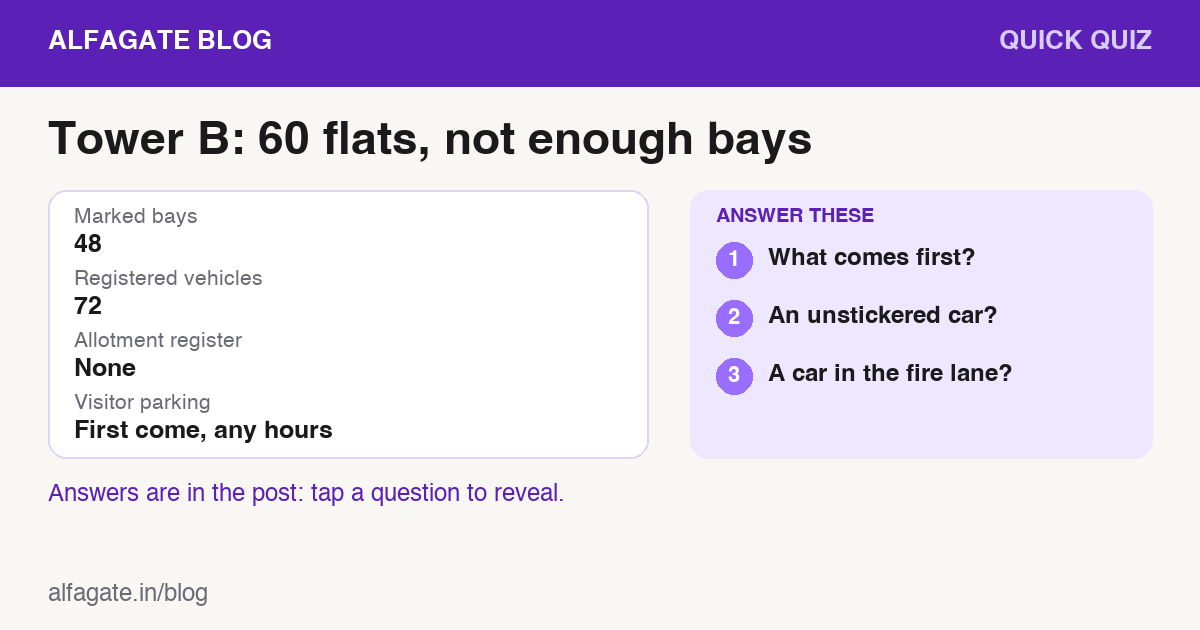
Q1. Before writing any rule, what should the committee do first?
- A. Print penalty notices
- B. Count slots, vehicles and current allotments
- C. Buy wheel clamps
Show answer
B. Three numbers frame the problem: slots available, vehicles registered, slots allotted. Most societies don't know the third.
Q2. Under the policy, how is a vehicle with no registered sticker treated?
- A. As a resident's vehicle
- B. As a visitor's vehicle
- C. As illegal and towed at once
Show answer
B. Registering every vehicle and treating the rest as visitors removes most 'whose car is this?' calls to the guard.
Q3. A resident's car is parked in the fire-engine lane. What is the right response?
- A. Ignore it, it is only for an hour
- B. Treat it as a safety breach: photograph, notice, removal as the policy allows
- C. Let the guard deflate the tyres
Show answer
B. Fire lanes and exits are safety issues with explicit rules. Never deflate tyres or clamp without a clear rule and legal advice.
Got a question your society is stuck on? Send it to us, and we may answer it in a future post.
How AlfaGate helps
AlfaGate has parking management built in: the committee records every slot, assigns it to a flat, and can reassign, revoke or block it, with the history kept, so the register is a screen rather than a notebook. Residents see their own slots in the app, parking charges can be generated onto the flat's bill with everything else, and at the gate residents pre-approve visitors so the guard knows who is expected and for which flat. To see how it would work for your parking layout, book a demo.
General information for housing society committees, not legal advice. Rules on allotment, charges and enforcement depend on your state's law, your bye-laws and the terms of the original sale. Check with your society's legal adviser before introducing charges or penalties.

Khunt Jenish P.
Software developer at AlfaStack, building AlfaGate to make society management smarter, simpler, and more connected.