Fire Safety Audit Checklist for Housing Societies
What to check weekly, monthly and yearly, who signs it off, and the five findings that turn up in almost every society, plus a one-hour committee walk.
Most fire-safety systems in housing societies fail the same way: they exist, but nobody has checked them since the day they were installed. The extinguisher on the third-floor landing is two years past its refill date, the stairwell door is wedged open with a shoe rack, and the alarm panel has been showing a fault light since the last monsoon. This fire safety audit checklist for housing societies gives your committee a practical routine: what to check, how often, who signs, and what proof to keep.
Whose job is it?
In law, the responsibility sits with the owner or occupier of the building, which in a society means the managing committee acting for the society. In Maharashtra, for example, the Maharashtra Fire Prevention and Life Safety Measures Act, 2006 puts the duty to maintain fire-safety installations on owners and occupiers of notified buildings and requires periodic certification by a licensed agency. Other states have their own fire acts and rules, and which buildings are covered (usually by height or use) varies.
The practical point is the same everywhere: if something goes wrong, the committee will be asked, "What did you check, when, and where is the record?" A committee without records is in a weak position.
What to check, and how often
The schedule below is a sensible working routine. Your fire department's rules and your licensed agency's advice take priority over it.
| What | Who | How often |
|---|---|---|
| Fire exits and staircases: clear, unlocked, no storage | Committee member / facility manager | Weekly walk |
| Fire extinguishers: in place, pin intact, gauge in the green, tag current | Facility staff | Monthly |
| Extinguisher servicing and refills | Licensed vendor | At least yearly, or as the vendor's tag says |
| Fire alarm panel: no faults; test a call point | Facility staff / vendor | Weekly test, with a log |
| Sprinklers, hydrant valves and hose reels | Vendor | As per their maintenance schedule, with report |
| Fire pump and jockey pump: run test | Pump operator | Weekly run |
| Emergency lighting and exit signs | Facility staff | Monthly |
| Underground and overhead fire water tanks: level adequate | Facility staff | Monthly |
| Fire drill, with residents | Committee and security | At least once or twice a year |
| Formal inspection certificate from a licensed agency | Licensed agency, filed with the Fire Department | As your state requires. In Maharashtra, notified buildings typically submit a half-yearly certificate (Form B). Confirm the current rule. |
The five findings that appear in almost every society
- Blocked exits. Shoe racks, cycles, potted plants and old furniture in staircases and landings. It's the most common problem, and the one that costs lives, because people can't leave in the dark and in a hurry.
- Locked or wedged doors. Terrace doors locked "for security" and stairwell doors propped open. Fire doors only work when they're closed. A terrace that's locked is a refuge nobody can reach.
- Extinguishers nobody has inspected. Often the right type is installed but the pressure has dropped, or the refill date passed long ago.
- No evidence. Everything may be working, but there is no log, no vendor report, no signed checklist. Without records, you can't show that you did your duty.
- Residents don't know what to do. Nobody has told them where the assembly point is, or that they shouldn't take the lift.
Run a one-hour committee walk
You don't need to be an expert to find most of these problems. Once a month, take a committee member, the security supervisor and a phone camera:
- Walk every staircase from top to bottom, opening every fire door. Photograph anything blocking it.
- Check each extinguisher's tag, pin and gauge. Photograph the tag.
- Look at the alarm panel. Is the fault light on? Photograph the display.
- Visit the pump room and the fire tank level.
- Test one alarm call point on each floor, rotating the floors each month.
- Write the date, your names and every issue on one page. Sign it.
Then close each issue with a date and a name. An unresolved note that sits for six months is worse than no note at all.
What to do with the findings
- Serious and cheap (exit blocked, door wedged): fix immediately, and send a firm notice to the residents responsible.
- Needs a vendor (extinguisher refills, alarm fault, pump repair): raise a work order the same day and keep the quote and the invoice.
- Needs money: put it on the agenda of the next managing committee meeting, with a quote, and record the decision. If the cost exceeds the committee's financial powers, take it to the general body.
- Residents' behaviour: communicate through notices, an app broadcast and a floor-wise reminder. Name the problem, not the person.
Drills that people don't hate
A fire drill that is announced a week in advance, at 11 am on a Sunday, and ends with tea is a drill that people will attend. Keep it short:
- sound the alarm
- guards direct residents to the staircases, not the lifts
- everyone gathers at the assembly point
- headcount by wing or floor
- a five-minute debrief: what went well, what didn't
Photograph the assembly. It's also your proof.
Quick quiz: the monthly walk
This is what the committee found on a monthly walk. Read the card, then pick your answers. Tap a question's button to reveal the answer.
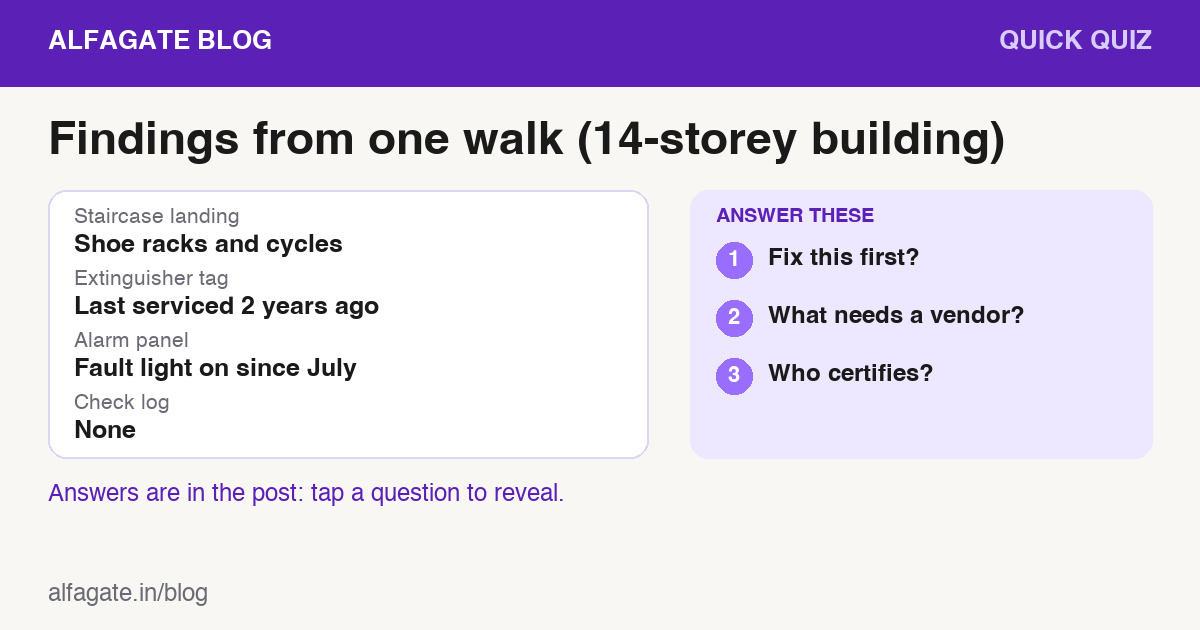
Q1. Which finding should be fixed immediately, today, at almost no cost?
- A. The blocked staircase
- B. Repainting the panel
- C. Buying more extinguishers
Show answer
A. A blocked exit stops people leaving in the dark and in a hurry. It costs nothing to clear, so do it the same day and send a notice to the residents responsible.
Q2. Which of these needs a licensed vendor and a work order?
- A. Moving a cycle
- B. The alarm panel fault and the overdue extinguisher servicing
- C. Closing a propped-open door
Show answer
B. Servicing equipment and fixing alarm faults needs a vendor. Raise the work order the same day and keep the quote, invoice and service report.
Q3. Who should issue the formal periodic fire-safety certificate for the building?
- A. The society secretary
- B. A licensed fire-safety agency, filed as your state requires
- C. Nobody, if the extinguishers look fine
Show answer
B. Where a state's fire law covers your building, a licensed agency provides the certificate. Confirm the schedule and what applies with your fire department.
Got a question your society is stuck on? Send it to us, and we may answer it in a future post.
How AlfaGate helps
Fire safety is mostly about routine and records. In AlfaGate, residents can raise complaints, such as a blocked staircase, from the app and the committee can track them to closure. Notices from the committee can go out through the app, which is how you tell people about a drill. If you'd like to see how, book a demo.
General information for housing society committees, not professional fire-safety advice. Requirements depend on the building's height and use and on your state's fire law. Confirm what applies to your building with your fire department and a licensed fire-safety agency.

Khunt Jenish P.
Software developer at AlfaStack, building AlfaGate to make society management smarter, simpler, and more connected.